October was another eventful month for the markets. From AI-fueled stock gains to shifting inflation data and surprising signals from the Fed, investors had plenty to digest. Here’s a simple breakdown of what mattered and why it may shape the months ahead.
A Month of Mixed Signals and Big Moves in Tech
Global markets wrapped October on a mixed note, but for equity investors, the momentum was undeniable. According to AssetMark’s October 2025 Market Review, stocks continued their upward climb while global bonds ended the month modestly lower as inflation remained sticky and global borrowing costs stayed elevated.
Returns as of October 31, 2025
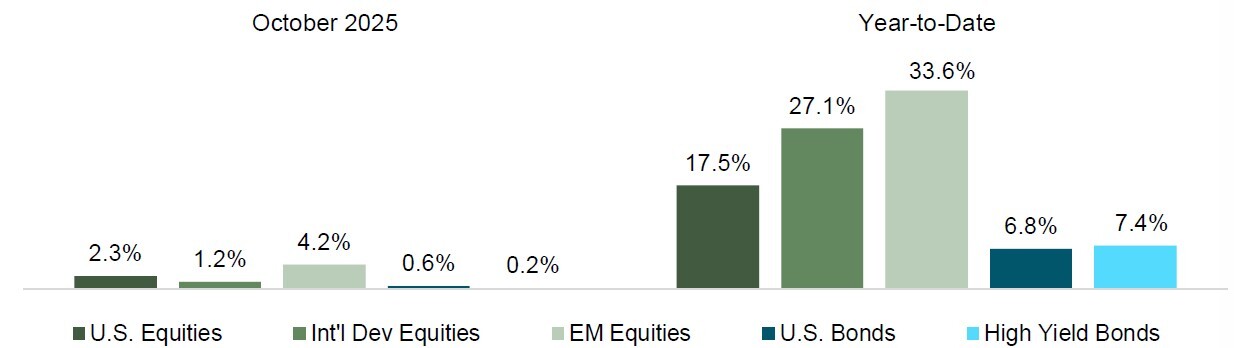
Source: FactSheet
U.S. Markets: AI Still in the Driver’s Seat
The S&P 500 logged its sixth straight month of gains, up an impressive 37% from its April lows. Three forces powered the rally:
-
Easing trade tensions
-
Strong corporate earnings
-
Surging investment in artificial intelligence
Technology remained the strongest performer by far, as companies continued to pour capital into AI infrastructure, talent, and research. But this rapid rise has a flip side: renewed optimism has pushed U.S. equity markets back near all-time highs, raising questions about overconcentration and whether the AI trade is becoming too crowded.
We’ve seen these cycles before. When one theme dominates, it’s easy to forget that great portfolios aren’t built on a single idea. As we often remind clients: markets reward diversification, not trend-chasing.
A Tale of Divergence
While mega-cap tech soared, other segments lagged behind:
-
Dividend and value stocks
-
Small- and mid-cap stocks
-
More cyclical sectors
This gap reinforces why having exposure across sectors, styles, and market caps remains essential—even in headline-grabbing markets like this one.
International Markets: A Quiet Strength Building Abroad
International equities also saw meaningful gains, particularly in Asia.
-
Japan rallied following the election of a new prime minister whose policies the market views as supportive of growth.
-
South Korea and Taiwan benefited from improved U.S.–China trade relations, a welcome tailwind for economies heavily reliant on electronics and AI manufacturing.
While international markets rarely steal the spotlight from U.S. tech, they continue to play a critical role in creating balanced, resilient portfolios.
Bonds: Cooling Inflation Helps—But The Fed Adds Uncertainty
Inflation data finally showed signs of easing, and in response, the Federal Reserve cut rates by 25 basis points to a range of 3.75–4.00%. That move helped push U.S. bond prices higher temporarily.
But there was a twist.
Fed Chair Jerome Powell surprised markets by casting doubt on a possible December rate cut, injecting a dose of uncertainty into fixed income markets. With yields still elevated globally, bonds were mixed for the month and ended slightly lower overall.
For long-term investors, this remains a period where patience and discipline matter more than reacting to headlines. Fixed income markets are still working through the ripple effects of higher-for-longer rate expectations.
Gold: A Rally Pauses
Gold continued its record-setting run, but October brought its first meaningful pullback in months as investors took profits off the table.
Global Markets Returns as of October 31, 2025
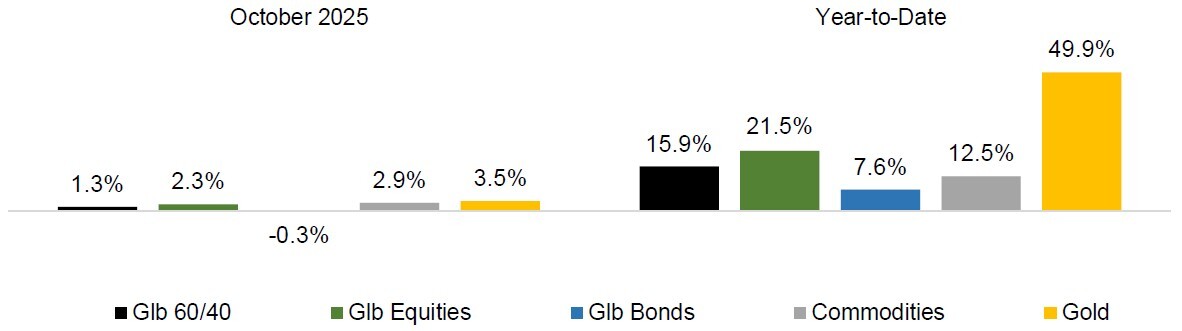 Source: FactSheet
What This Means for Long-Term Investors
When months like October come around—full of strong returns but also rising questions—the biggest risk is getting caught up in the excitement.
Here are three EmVision takeaways:
1. Concentration can be a double-edged sword
Yes, AI investments are powering real growth. But when one sector dominates returns, portfolios can become unintentionally unbalanced.
2. Global diversification adds stability
Japan, South Korea, and Taiwan all showed why international exposure matters. Growth comes from more places than the S&P 500.
3. Bonds are still doing their job—even in a confusing rate environment
Volatility in fixed income doesn’t diminish its role as a stabilizer and income generator.
Our Perspective
Markets don’t move in straight lines, even when headlines make it feel like they do. Your financial plan is built to weather both the breakthroughs—like AI’s ongoing transformation—and the uncertainties—like rates and inflation that refuse to behave exactly as expected.
As always, we’re here to help you stay healthy, wealthy, and wise, and to ensure your investment strategy supports the life you want to live.
If you’d like to discuss how these trends impact your personal plan, our team is always here. Contact us today.
Michael Embrescia is a financial advisor located at EmVision Capital Advisors, 251 W. Garfield Rd. Suite 155 Aurora, OH 44202. He offers securities and advisory services as an Investment Adviser Representative of Commonwealth Financial Network®, Member FINRA/SIPC, a Registered Investment Adviser. He can be reached at (330) 954-3770 or at info@emvisioncapital.com.
Securities and advisory services offered through Commonwealth Financial Network®, Member FINRA/SIPC, a Registered Investment Adviser. Additional advisory services offered through EmVision Capital Advisors, LLC are separate and unrelated to Commonwealth. Fixed insurance products and services are separate from and not offered through Commonwealth Financial Network. Registration as an Investment Adviser does not imply any level of skill or training.
Important Information
This is for informational purposes only, is not a solicitation, and should not be considered investment, legal or tax advice. The information has been drawn from sources believed to be reliable, but its accuracy is not guaranteed and is subject to change. Investors seeking more information should contact their financial advisor. Financial advisors may seek more information by contacting AssetMark at 800-664-5345.
Investing involves risk, including the possible loss of principal. Past performance does not guarantee future results. Asset allocation cannot eliminate the risk of fluctuating prices and uncertain returns. There is no guarantee that a diversified portfolio will outperform a non-diversified portfolio. No investment strategy, such as asset allocation, can guarantee a profit or protect against loss. Actual client results will vary based on investment selection, timing, market conditions, and tax situation.
It is not possible to invest directly in an index. Indexes are unmanaged, do not incur management fees, costs, and expenses, and cannot be invested in directly. Index performance assumes the reinvestment of dividends.
Investments in equities, bonds, options, and other securities, whether held individually or through mutual funds and exchange-traded funds, can decline significantly in response to adverse market conditions, company-specific events, changes in exchange rates, and domestic, international, economic, and political developments.
Bloomberg® and the referenced Bloomberg Index are service marks of Bloomberg Finance L.P. and its affiliates (collectively, “Bloomberg”) and are used under license. Bloomberg does not approve or endorse this material nor guarantees the accuracy or completeness of any information herein. Bloomberg and AssetMark, Inc. are separate and unaffiliated companies.
AssetMark, Inc. is an investment adviser registered with the U.S. Securities and Exchange Commission. AssetMark and third-party strategists and service providers are separate and unaffiliated companies. Each party is responsible for their own content and services.
©2025 AssetMark, Inc. All rights reserved. 8592573.1 | 11/2025 | EXP 11/2027




 (330) 954-3770
 info@emvisioncapital.com
 251 W. Garfield Rd. Suite 155 Aurora · OH · 44202